Scaling Social Media for Furniture Brands with AI Content
 Amanda Mao
In 2026, the challenge for high-end furniture brands is not simply taking one exceptional photograph. It is staying visually fresh on a daily basis across multiple global markets.
A standard professional shoot might deliver 50 polished images — enough content for perhaps one month of scheduled posting. But the Instagram algorithm rewards variety and novelty, and your audience in Tokyo has fundamentally different aesthetic expectations than your audience in Notting Hill.
This is where the main interior brands guide meets the operational reality of social media at scale.
The Problem: "Scroll Fatigue"
If you post the same studio shot of your signature armchair three times across a month, your engagement drops noticeably. If you post that same armchair staged in the same room ten times, the Instagram algorithm stops surfacing your content entirely. It reads as repetition, and repetition signals low-effort content.
To sustain a premium digital presence in a competitive feed, you need environment variety — the ability to show the same hero product in multiple contexts, moods, and cultural settings without the cost and logistics of physically moving your inventory.
The Strategy: Hyper-Localization Through AI Rendering
Visualising one product across multiple global contexts allows you to speak authentically to different geographic segments without ever relocating your furniture or hiring local photographers in each market.
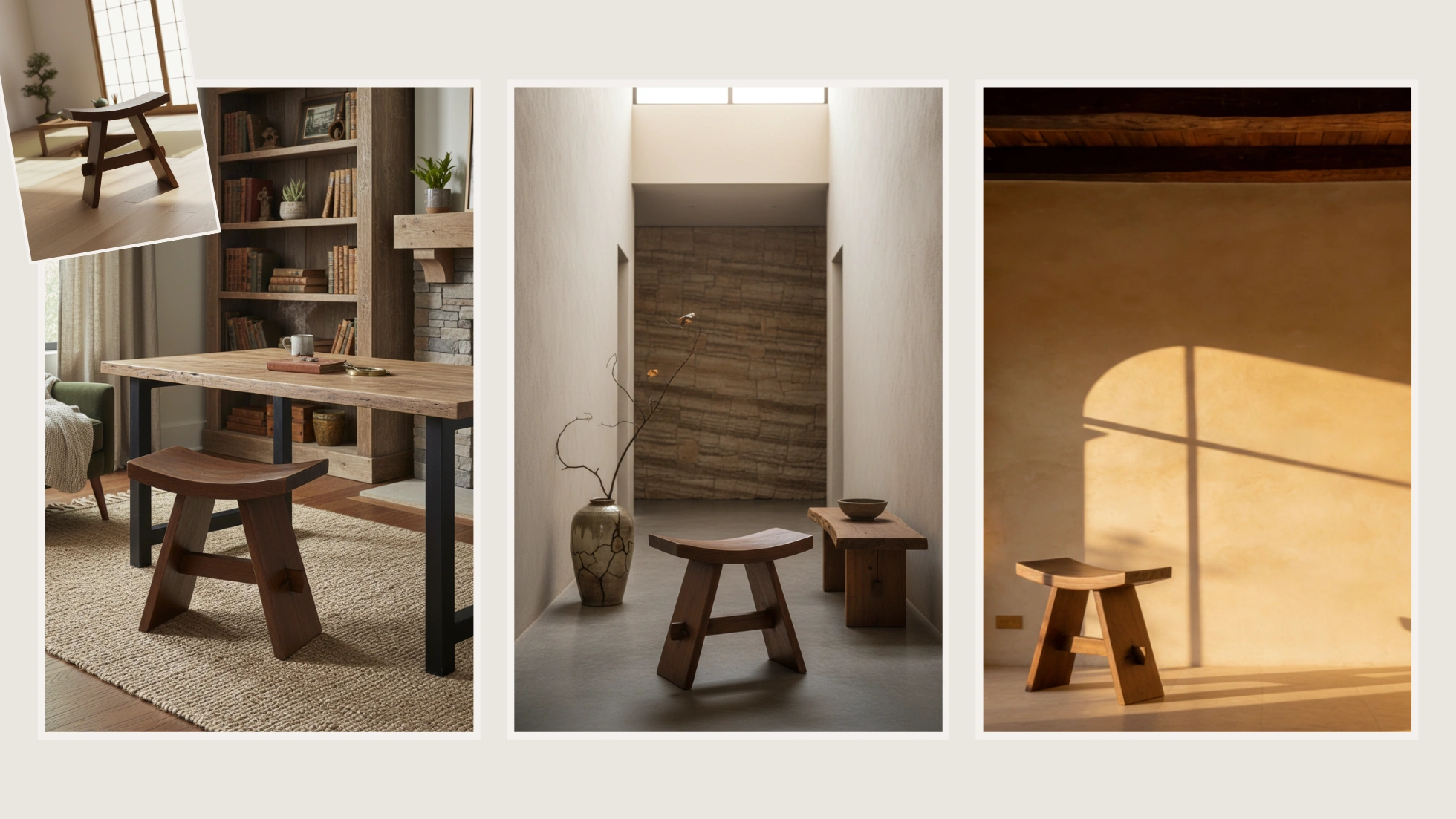
The "One Stool, Ten Cities" Test
Using Clara, we took a single walnut barstool from a London-based brand and, in the span of one hour, generated lifestyle renders for:
A minimalist penthouse in Manhattan, with floor-to-ceiling glass and urban views.
A warm, traditional Shaker-style kitchen in The Cotswolds, complete with exposed beams.
A brutalist industrial loft in Berlin, featuring polished concrete and metal fixtures.
A sun-drenched terrace in Santorini, with whitewashed walls and Mediterranean light.
A sleek, high-tech studio apartment in Tokyo, styled with Japanese minimalist principles.
Each render maintained the exact material fidelity of the original walnut barstool while adapting the surrounding environment to match the cultural and architectural expectations of the target market.
The Results
Ad Spend Efficiency: By geo-targeting ad creative to match the viewer's city — showing the Santorini terrace to users in Southern Europe and the Berlin loft to users in Germany — click-through rates (CTR) increased by 45% compared to generic product shots.
Organic Engagement: Users began tagging friends with comments like "This is literally your loft" or "We need this for the terrace," driving peer-to-peer sharing and expanding organic reach without additional spend.
Content Longevity: Because each render felt contextually distinct, the brand was able to post the same product multiple times across different feeds without triggering audience fatigue or algorithmic penalties for repetition.
Workflow: The 1-Hour Content Batch
Instead of waiting three weeks for a traditional production cycle, your social media manager can now generate an entire month's worth of geo-targeted, platform-optimised content in a single afternoon.
Step 1 — Select the Hero Asset: Choose your latest flagship product or a bestselling item that deserves sustained visibility across multiple markets.
Step 2 — Define Target Personas: Identify four to six demographic and geographic segments. Examples might include "The Urban Minimalist" (New York, London), "The Country Classicist" (Cotswolds, Provence), "The Coastal Modernist" (Sydney, Santorini), and "The Industrial Purist" (Berlin, Copenhagen).
Step 3 — Render with Clara: Use Clara to generate five to ten environment variations for each persona. Input the specific architectural and cultural markers that will resonate with that audience — exposed brick for industrial markets, soft neutrals and natural light for Scandinavian minimalists, bold colour and texture for Mediterranean audiences.
Step 4 — Schedule and Deploy: Load the rendered content into your scheduling tool and deploy the appropriate variation to each geographic feed. Instagram's geo-targeting capabilities allow you to show the Berlin loft exclusively to users in Germany, the Tokyo studio to users in Japan, and so on.
Pro Tip: Use Clara to generate AI-powered video clips showing natural light shifting across the furniture throughout the day. These short video loops are highly effective at stopping the scroll on TikTok and Instagram Reels, where motion content consistently outperforms static images.
Protecting Brand Integrity at Scale
While this guide emphasises volume and variety, it is critical that high-frequency content still maintains the premium aesthetic standards your brand is known for.
Clara ensures that the walnut grain, upholstery texture, and finish quality of your barstool appear identical whether it is rendered in a Berlin loft or on a Santorini terrace. The environment changes; the hero product does not. This protects the "flagship" status of your piece while providing the algorithmic variety that social platforms reward.
The Bottom Line: Do not let your social media feed stall in the content gap between professional shoots. Use AI to generate the high-quality environment variety the algorithm demands — without sacrificing the material precision and brand integrity your audience expects.
Frequently Asked Questions
Q: What is scroll fatigue in social media marketing?
A: Scroll fatigue occurs when an audience repeatedly sees the same or visually similar content from a brand, leading to declining engagement and algorithmic suppression. On platforms like Instagram and TikTok, the algorithm interprets repetitive content as low-effort and stops surfacing it to users. For furniture brands, this often happens when the same product is photographed in the same showroom or studio setting multiple times.
Q: How does AI-generated content help furniture brands scale social media?
A: AI-powered lifestyle rendering tools like Clara allow furniture brands to generate dozens of contextually distinct images of the same product in different rooms, architectural styles, and geographic settings — all without physical photoshoots. This provides the environment variety that social media algorithms reward, while keeping production costs and timelines minimal.
Q: What is hyper-localization in furniture marketing?
A: Hyper-localization is the practice of tailoring visual content to match the cultural, architectural, and aesthetic preferences of specific geographic markets. For example, showing a sofa in a minimalist Tokyo apartment for Japanese audiences and the same sofa in a rustic Cotswolds cottage for UK audiences. AI rendering makes this scalable by eliminating the need for location-based photoshoots.
Q: Can AI-generated social content maintain luxury brand standards?
A: Yes, when executed with precision. Clara's Material Consistency Engine ensures that product textures, finishes, and proportions remain photorealistic and accurate across all generated environments. The key is to treat AI rendering as a tool for environment variety — not as a replacement for the craftsmanship and detail that define luxury furniture itself.
Q: How much time does AI content generation save compared to traditional photoshoots?
A: A traditional professional furniture photoshoot typically requires two to three weeks of planning, coordination, and post-production, and produces 50 to 100 images. Using Clara, a social media manager can generate the same volume of geo-targeted lifestyle images in approximately one hour, with no need for photographers, stylists, or location rentals.
Q: What keywords should furniture brands target for AI content marketing?
A: High-value primary keywords include "AI social media content," "furniture brand content strategy," and "hyper-localized marketing." Long-tail opportunities include "how to scale furniture brand social media," "AI-generated lifestyle images for Instagram," and "social media scroll fatigue solutions." Location-specific terms such as "Tokyo interior design content" or "Manhattan furniture ads" are also effective for geo-targeted campaigns.
Clara is an AI-powered lifestyle rendering platform built by GenesAI, designed to help luxury furniture and interior brands generate hyper-localized, photorealistic social media content at scale without the cost and logistics of traditional photography.