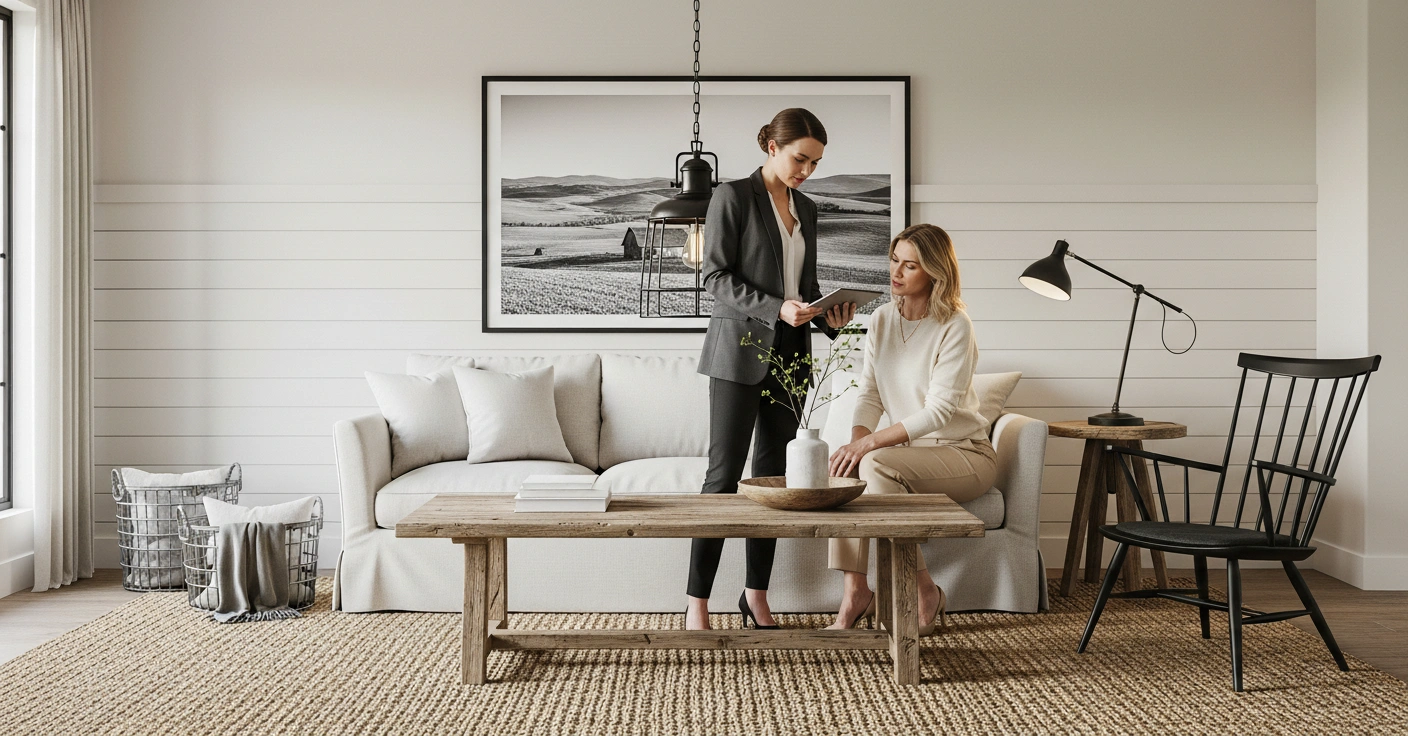
Visual Closing: The Sales Psychology Behind Luxury Furniture
 Amanda Mao
Beyond the Swatch: The Sales Psychology of Visual Closing
"I love it, but… I need to go home and check the measurements."
This "but" is the sound of a sale stalling. In luxury furniture sales, we call this the Imagination Gap — and it is the single biggest reason high-end showrooms on Kings Road lose deals at the point of commitment.
While we cover the economics of visual content at scale in our earlier blog, this article deep-dives into the psychology of the close — and how AI-powered visualisation turns hesitation into confidence.
The Fear of Regret: The "Costly Mistake" Bias
When a customer walks into your showroom, they are not simply buying furniture. They are buying a lifestyle. But unlike a jacket or a pair of shoes, a £5,000 sofa is a near-permanent commitment to a physical space.
This creates three distinct psychological barriers for the buyer:
Risk Aversion — "What if it makes the room look too dark?" The buyer fears an irreversible aesthetic mistake in a space they live with every day.
Scale Anxiety — "Will it swallow the space?" Without seeing the piece in context, even experienced buyers misjudge proportion. A sofa that looked generous on the showroom floor may feel cavernous in a Victorian semi.
Colour Conflict — "Will forest green clash with my existing inherited rug?" Inherited and sentimental furnishings add an emotional layer that no amount of verbal reassurance can resolve.
When a client says "I need to check," they are not reaching for a tape measure. They are managing their fear of regret.
The 48-Hour "Ghost Phase"
Research into high-value purchase behaviour shows that for roughly 30% of showroom visitors, the decision to "check at home" is where the lead dies entirely. Three forces drive this:
Energy Drop — Once the client leaves the tactile, curated environment of the showroom, the emotional pull of the piece fades rapidly. Touch, lighting, and spatial context are gone.
Decision Fatigue — Measuring the room, comparing dimensions with existing furniture, and negotiating with a partner transforms what was an exciting discovery into an administrative task.
Algorithm Interruption — The moment the client opens their phone at home, retargeting ads from competitor brands flood their feed, diluting the emotional connection they built in your showroom.
The solution is clear: close the Imagination Gap before the client exits the door.
High-Conversion Scripts for Showroom Staff
The most effective luxury showrooms in 2026 have shifted from Passive Sales — where the swatch is handed over and the hope begins — to Visual Closing, where the sale is functionally decided in the room.
Scenario 1: The "Maybe" Pivot
Client: "I love this Ochre velvet, but I'm worried it's too bold for my flat."
Sales Associate: "That's a really fair concern — Ochre is a statement colour. Do you have a photo of the room on your phone? I'd love to digitally stage it for you right now so we can see exactly how that fabric reads against your walls and light."
Scenario 2: The "Scale Check"
Client: "I think the L-shape might be too big for our lounge in Notting Hill."
Sales Associate: "It's genuinely hard to judge without context — that's one of the trickiest parts of buying a sofa. If you give me the rough dimensions of your room, I can render this piece in a comparable architectural space on my tablet. We can see whether it leaves room for your side tables and circulation."
Both scripts share a structure: validate the concern, invite collaboration, and move to visual proof within 30 seconds.
Deep Dive: The "Proof of Concept" Advantage
Using Clara on a tablet in-showroom delivers approximately 90% of the confidence that a full home trial provides — with none of the logistical overhead of delivery, installation, and return.
Tactical Goal | Traditional Approach | Visual Closing with Clara |
|---|---|---|
Trust Building | "Trust me, it will look great in there." | "Here — see for yourself, in your actual room." |
Objection Handling | Descriptive language and experience. | Immediate, photorealistic visual evidence. |
The "Take-Home" Asset | A cardboard fabric swatch. | A high-resolution render of their home, styled with their piece. |
Why this changes the psychology of the sale: When you send a client home with an AI-generated render of your furniture placed in their actual living room, you do not leave them "thinking about it." You leave them looking at the finished result. The decision has already been made visually — your job is simply to confirm it.
Implementation: The 15-Minute Staff Training
Closing the visualisation gap does not require a technical overhaul. It requires a repeatable three-step habit:
Step 1 — The Trigger: Train your floor staff to recognise the "I need to imagine it" moment. It usually arrives with a hesitation, a glance around the showroom, or the phrase "it's lovely, but…"
Step 2 — The Ask: Always request a photo of the client's room early in the consultation — ideally before they have committed to a specific piece. Frame it casually: "Would you mind snapping a quick photo of the space? It helps me give you a much more accurate recommendation."
Step 3 — The Render: Use Clara's Lifestyle Mode to place the showroom piece into the client's photograph in under 60 seconds. Hand them the screen. Let them see it.
Reported ROI: Showrooms using Visual Closing consistently report a 30% reduction in ghosted leads and a measurably shorter sales cycle from first visit to confirmed order.
To understand the back-end economics of how Clara generates these renders at scale across an entire product catalogue, read our ROI & Frequency Guide in this article.
Frequently Asked Questions
Q: What is the Imagination Gap in luxury furniture sales?
A: The Imagination Gap is the moment a potential buyer sees a piece they like in a showroom but cannot confidently picture it in their own home. This disconnect between emotional desire and spatial confidence is the leading cause of stalled deals in high-end furniture retail. AI visualisation tools like Clara are specifically designed to bridge this gap in real time.
Q: How does visual closing work in a furniture showroom?
A: Visual closing is a sales technique in which a showroom associate uses AI-powered room visualisation software to place a piece of furniture into a photograph of the client's actual living space. Rather than asking the buyer to imagine how a sofa or table will look, the associate produces a photorealistic render on a tablet within seconds, allowing the client to see the result before they leave the showroom.
Q: Why do luxury furniture leads go cold after leaving the showroom?
A: Three factors drive this: the emotional pull of the piece fades once the client leaves the tactile showroom environment; the process of measuring, comparing, and discussing with a partner introduces decision fatigue; and competitor retargeting ads begin flooding the client's phone the moment they get home. Together, these create what is known as the 48-hour Ghost Phase.
Q: Can AI furniture visualisation replace a home trial?
A: AI visualisation does not replicate the physical experience of touching and sitting on a piece of furniture, but it addresses the primary reason clients request home trials — uncertainty about how the piece will look and fit in their space. Clara’s AI visualisation delivers approximately 90% of the visual confidence of a home trial, without the cost and logistical complexity of delivery and returns.
Q: What results do showrooms see from using visual closing techniques?
A: Based on industry benchmarks for visual selling techniques, we expect Clara to reduce ghosted leads by up to 30% and accelerate the sales cycle by increasing buyer confidence earlier in the process. The key metric is not just conversion rate, but the speed at which a buyer moves from “interested” to “confident.” Visual proof compresses that timeline and helps sales teams close with greater certainty.
Q: How long does it take to train showroom staff on AI visualisation?
A: The core workflow — identifying the trigger moment, requesting a room photo, and generating a render — can be taught in approximately 15 minutes. The skill becomes faster and more natural with repetition, and Clara's interface is designed to require no technical expertise from the sales associate.
Q: What keywords should luxury furniture brands target for AI visualisation content?
A: High-value targets include "visual closing," "luxury furniture sales psychology," "AI furniture visualisation," "showroom conversion," and location-specific terms such as "Westbourne Grove furniture showroom." Long-tail queries like "how to close a luxury sofa sale" and "AI room staging for retailers" are also strong opportunities with lower competition.
Clara is an AI-powered visualisation tool built by GenesiAI, designed to help luxury interior and furniture brands convert showroom interest into confirmed sales through real-time, photorealistic room rendering.